
Hamilton County's seat
Spray Foam Insulation in Noblesville, IN
From 1880s Victorians near the courthouse to subdivisions built since 2000, Noblesville has both ends of the housing spectrum.
- Free on-site estimates
- Written quotes that list material, thickness and R-value for each area
- Air leaks, moisture and old insulation checked before anything is covered
Old Core, New Edges
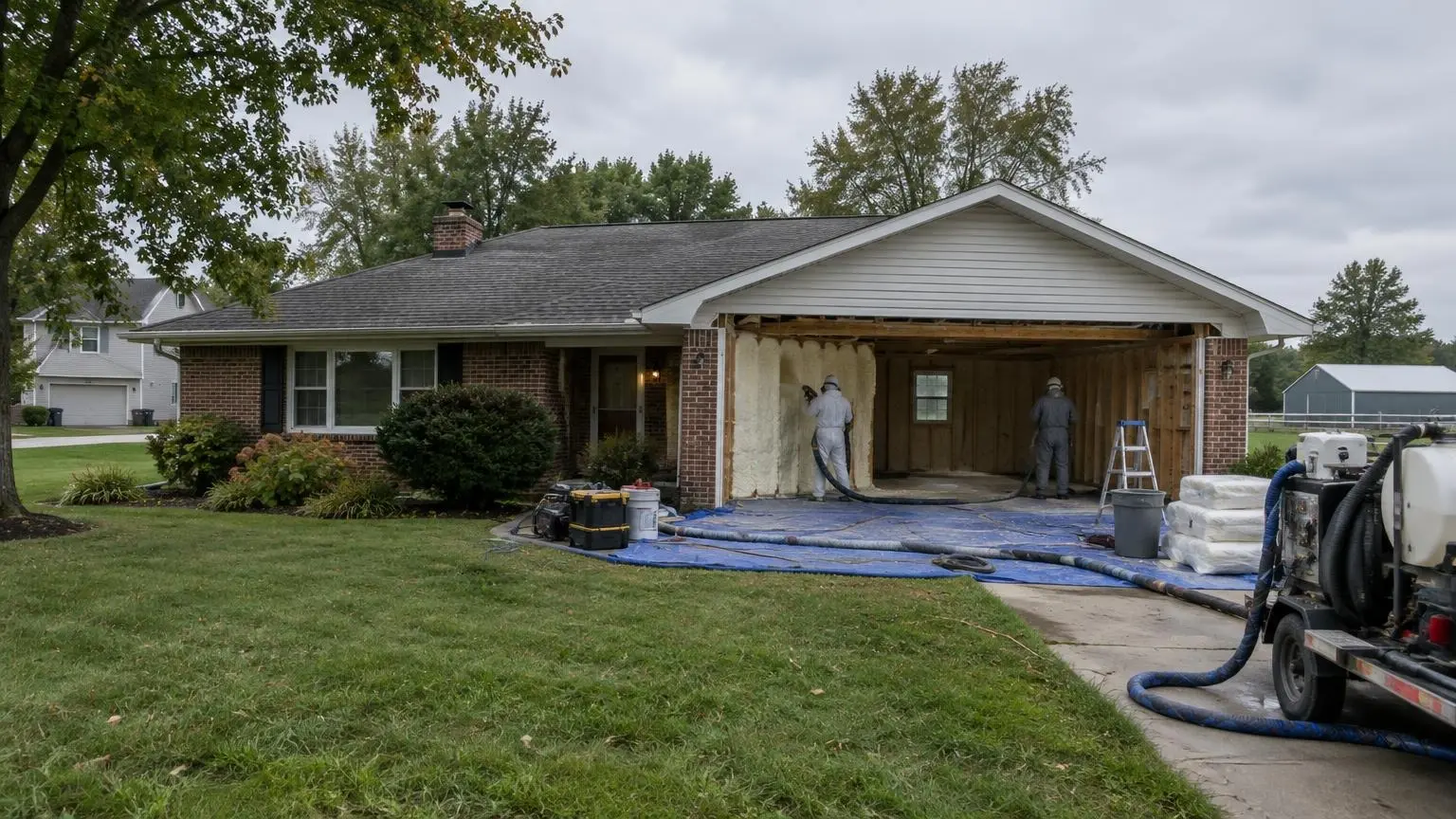
Spray foam insulation in Noblesville means two very different kinds of jobs. Near the courthouse square, many houses date from the Indiana gas boom: Wikipedia notes that Noblesville's first natural gas well was found in 1888 near 11th and Pleasant streets, and that many Victorian homes and most of downtown were built in that period. Out at the edges of the city, the houses are much newer. The population went from 7,548 in 1970 to 28,590 in 2000 and 69,604 in 2020, and the 2020 census counted 27,101 housing units.
Victorian and early 1900s homes
The Catherine Street, Conner Street and South 9th Street historic districts, plus the downtown commercial district, are listed on the National Register. Houses of that age usually have balloon framing, where wall studs run from the foundation to the roof with nothing to stop air rising inside the walls. They often have plaster walls, steep roofs, attic rooms, and basements or crawl spaces of stone or brick. Foam is a good tool for blocking the tops and bottoms of those open cavities and for sealing rim areas that were never built to be tight. We check for knob-and-tube wiring and for moisture in old foundations before covering anything.
Keeping old houses able to dry
Old masonry foundations and solid-plank sheathing behave differently from modern assemblies. Closed-cell foam on a damp stone foundation wall can push moisture somewhere else. We look at drainage, the condition of the mortar and any signs of water before recommending foam below grade, and sometimes a different approach makes more sense.
Newer subdivisions
In the neighborhoods built since the 1990s, the usual list applies: rim joists, bonus rooms over garages, attic hatches, recessed lights and knee walls. Many of these homes sit over crawl spaces or basements on the same poorly drained till soils found across central Indiana. The USDA describes the common Crosby series as somewhat poorly drained with a perched water table 0.5 to 2 feet down in winter and spring, so crawl space moisture is worth checking even in a newer house.
Gas boom wiring and old materials
Homes built during and after the 1888 gas boom have seen generations of updates. It is common to find a mix of old wiring, newer circuits and abandoned gas lines in attics and walls. Knob-and-tube wiring should not be buried under insulation until an electrician has looked at it. We also watch for vermiculite in older attics and stop to recommend testing if we find it.
Mansard and steep roofs
The 1879 Hamilton County Courthouse and the 1876 Sheriff's Residence and Jail are both Second Empire buildings with mansard roofs, and some older homes in town share that style or have very steep roofs with small attics. Those roof shapes leave little room for loose fill. Foam from the inside of the roof framing or on the short attic floors is often the most practical way to insulate them.
Along the White River
The city sits along the White River at about 771 feet elevation. Homes in lower areas near the river and its creeks are more likely to have damp crawl spaces or basements. We check for water before quoting insulation work below the first floor. Get a free estimate
What to Know in Noblesville
- Gas boom houses. Noblesville's first natural gas well was found in 1888, and many Victorian homes and most of downtown were built during the gas boom (Wikipedia).
- Historic districts. The Catherine Street, Conner Street, South 9th Street and Noblesville Commercial historic districts are on the National Register (Wikipedia).
- Growth. Population rose from 7,548 in 1970 to 69,604 in 2020; the 2020 census counted 27,101 housing units (Wikipedia).
- Wet soils. Crosby soils on central Indiana till plains are somewhat poorly drained with a perched water table 0.5 to 2 feet down in winter and spring (USDA).
Noblesville Questions
Can you insulate a Victorian house in downtown Noblesville?
Yes, carefully. We seal the tops and bottoms of open wall cavities, insulate attics and rims, and check wiring and foundation moisture before covering anything.
Is spray foam safe on an old stone foundation?
Sometimes. If the wall is damp or the mortar is failing, foam can trap moisture. We look at the wall and drainage before recommending it.
My Noblesville home is new. Does the crawl space need work?
Check it. Local soils hold water in spring, and even new crawl spaces can run damp. A vapor barrier and sealed vents often help.
Can you insulate a house with a mansard or very steep roof?
Yes, though it usually takes foam rather than loose fill, since there is little attic floor. We look at access and framing depth first.
Free Estimates in Noblesville, IN
Noblesville homeowners: we will look and send a written price.
Spray Foam Insulation Near Noblesville
- Spray Foam Insulation in Indianapolis, IN
- Spray Foam Insulation in Carmel, IN
- Spray Foam Insulation in Fishers, IN
- Spray Foam Insulation in Westfield, IN
- Spray Foam Insulation in Zionsville, IN
- Spray Foam Insulation in Whitestown, IN
- Spray Foam Insulation in Lawrence, IN
- Spray Foam Insulation in Speedway, IN
- Spray Foam Insulation in Beech Grove, IN
- Spray Foam Insulation in Greenwood, IN
- Spray Foam Insulation in Franklin, IN
- Spray Foam Insulation in Greenfield, IN
- Spray Foam Insulation in McCordsville, IN
- Spray Foam Insulation in Brownsburg, IN
- Spray Foam Insulation in Avon, IN
- Spray Foam Insulation in Plainfield, IN
- Spray Foam Insulation in Danville, IN
- Spray Foam Insulation in Mooresville, IN
- Spray Foam Insulation in Martinsville, IN