
Open cell and closed cell
Spray Foam Insulation in Indianapolis, IN
Foam that fills every gap and stops air, sprayed where it pays back and sized to the R-value on your quote.
- Free on-site estimates
- Written quotes that list material, thickness and R-value for each area
- Air leaks, moisture and old insulation checked before anything is covered
Foam That Stops Air as Well as Heat
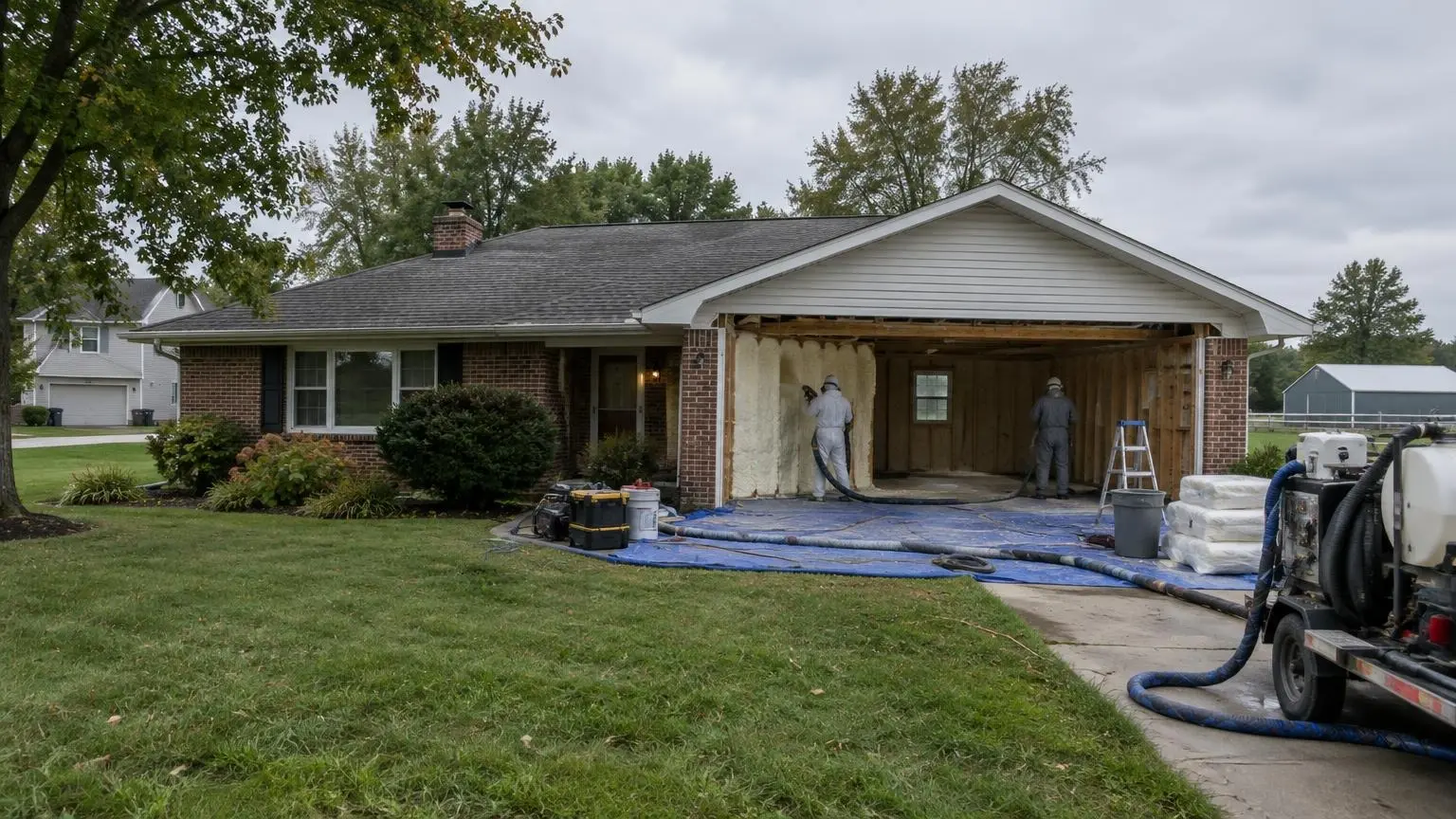
Spray foam insulation in Indianapolis earns its cost in the parts of a house where loose fill and batts struggle: the band joist on top of the foundation, crawl space walls, knee walls, sloped ceilings, garage ceilings under bedrooms and steel buildings. The two liquid components mix at the gun, swell into every crack and harden within minutes. That single layer cuts heat flow and blocks drafts at once, which fiberglass and cellulose cannot do on their own because air slips through them. In a city whose January nights average 20.9F and whose summer air averages more than 70% relative humidity, closing off drafts counts for as much as the R-value. There are two families of foam, and the choice between them comes first on every job.
Closed cell vs open cell
Think of closed-cell as the dense, hard option. HomeGuide rates it R-5 to R-7 for each inch. Its sealed cells shed liquid water, and at a couple of inches it acts as a vapor retarder, which is why it belongs against concrete, steel and other cold surfaces. It also adds stiffness to thin sheathing. Open-cell is the lighter, spongier option, rated R-3.5 to R-3.7 per inch by HomeGuide. It expands far more, fills odd cavities quickly and quiets noise, but vapor moves through it. In an Indiana winter that means it needs a vapor control layer on the room side, or an assembly designed to dry.
So the cold, damp and cramped spots in an Indianapolis house tend to get closed-cell: rim joists, foundation and crawl space walls, roof decks too shallow for a vent gap, and metal barns. Open-cell earns its place inside stud walls, between floors, in sound control and on attic rooflines where moisture is managed another way.
Sizing foam to the code
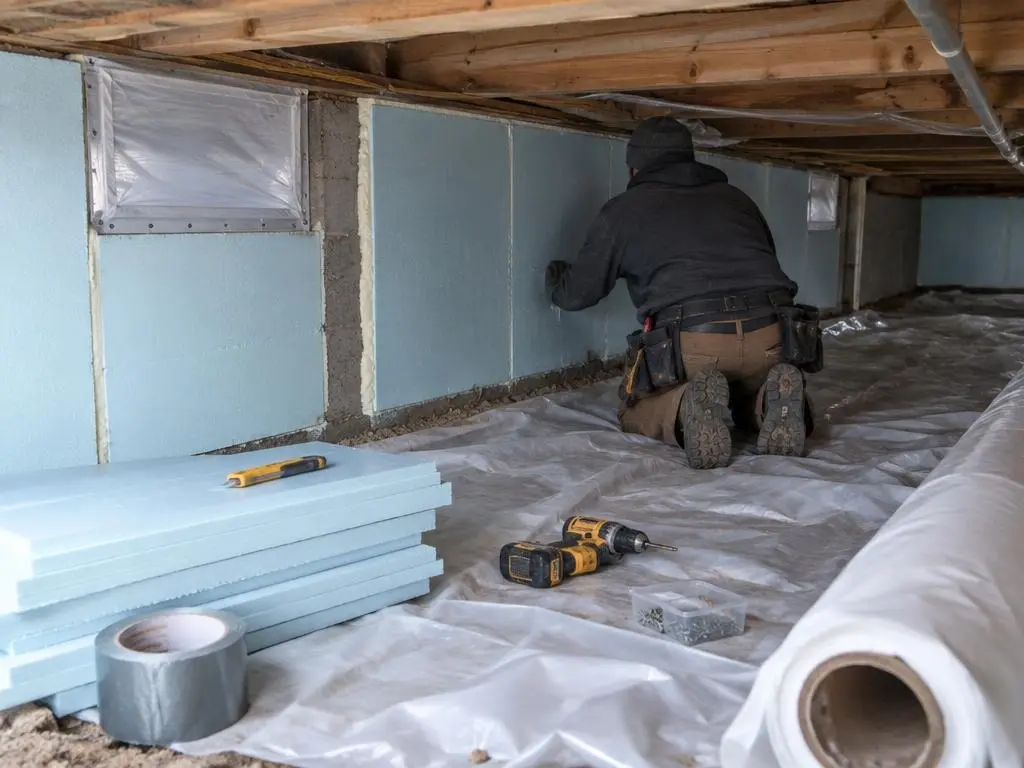
OpenEI lists Marion County and its neighbors in Climate Zone 5A. The Insulation Institute's summary of the 2020 Indiana Residential Code gives Zone 5 targets of R-38 for ceilings, R-20 or R-13 plus R-5 continuous for wood-frame walls, and R-13 or R-10 continuous for basement and crawl space walls. A 2x4 wall filled with open-cell lands near R-13; closed-cell reaches that in roughly 2 to 3 inches. Matching attic-level numbers on a roof deck with foam alone takes a lot of material, so we often combine foam with another product or save it for the vaulted sections. Every quote states the thickness we plan to spray and the R-value it should deliver.
Where foam goes in an Indianapolis house
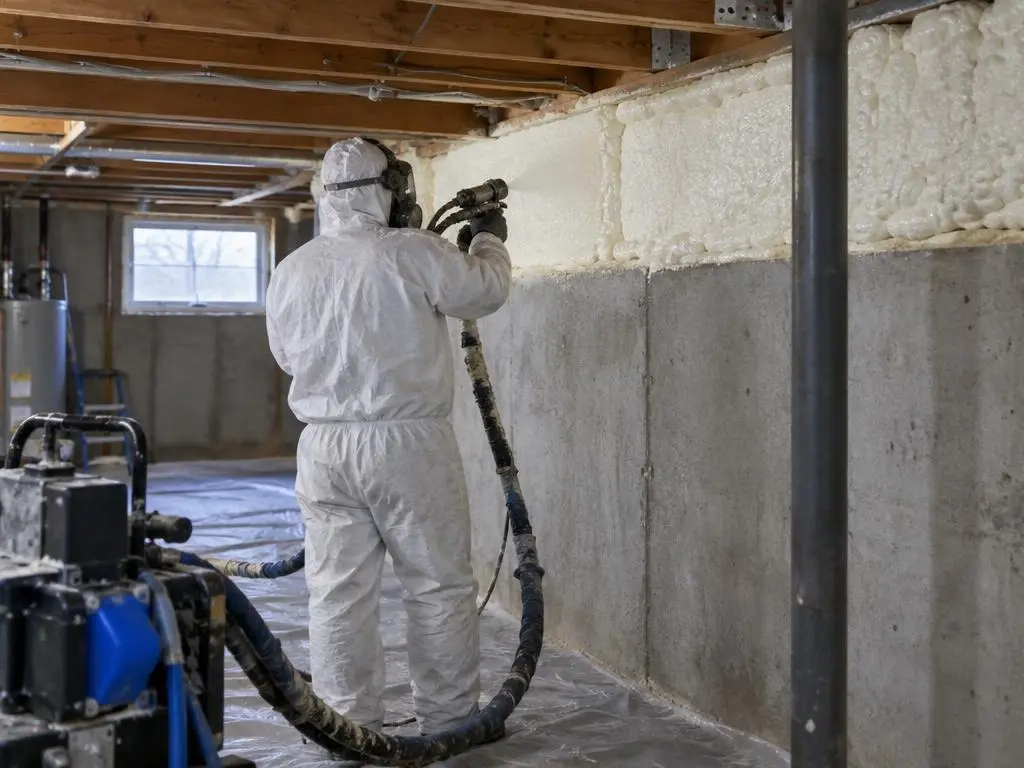
The band joist is the job we do most. It circles the house where the floor framing sits on the foundation, it is usually plain lumber with a scrap of fiberglass jammed in, and outside air seeps past it into the basement or crawl space all year. A two to three inch coat of closed-cell closes that path and insulates it in a single visit.
Higher up, foam goes on the knee walls of Cape Cods and bonus rooms, on the strip of attic floor behind those walls, on garage ceilings under bedrooms, on floors that overhang the foundation, and around the wire and pipe holes in an attic before loose fill is blown over the top. Older city houses often have open framing from floor to floor that lets warm air rise unchecked; a few inches of foam at the top and bottom of those cavities stops it.
Metal buildings and garages
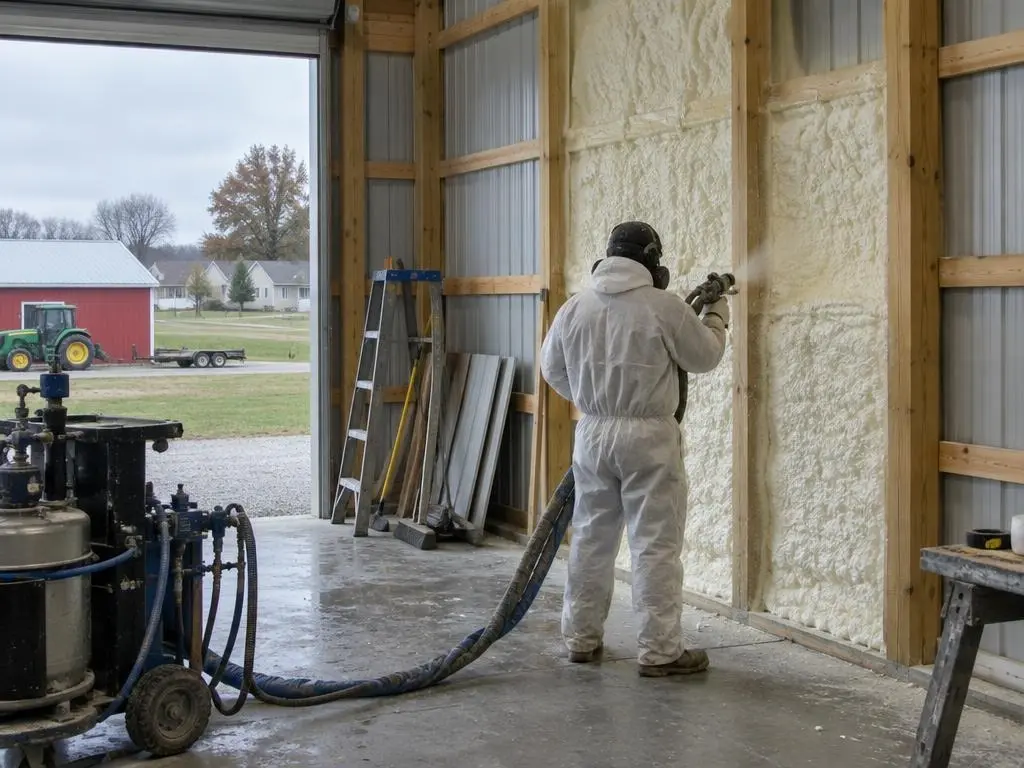
Steel sheds water well but sweats badly. When humid air meets a roof panel chilled by the night sky, droplets form and rain down on whatever is parked or stored below. Closed-cell sprayed onto the panels keeps that air off the metal and insulates in one coat. For a garage or shop you plan to heat, or work in on summer afternoons, foam on the walls and roof makes the space usable all year.
Where foam is the wrong call
Foam cannot cure a leak. Wet framing from a roof, window or pipe problem has to be dried and repaired first, or the foam simply hides rot. Old knob-and-tube circuits and vermiculite fill need to be checked before anything covers them. And across a big, open attic floor, foam is rarely the economical route to the target R-value; sealing the gaps and then blowing in cellulose or fiberglass usually costs less. We raise any of these before putting a price on paper.
Spray day and re-entry
The spraying itself goes quickly; the setup is what takes time. We drape floors and belongings, tape off windows, outlets and fixtures, and run fans to move air out of the work area. HomeGuide recommends staying out for 24 hours or more while the foam cures. For a basement or crawl space job, plan to be away for the day; for a detached barn, the house may not be affected. Foam only bonds and rises properly within a set temperature window, so cold rooms in winter get temporary heat or a different date. Once cured, it holds its shape for good, so what we spray is what stays.
Let us know which areas you have in mind and what is bothering you, whether that is a draft, a cold floor, a stuffy bonus room or a barn roof that drips. We will look, explain where foam is worth paying for, and put the price in writing. Get a free estimate
Where Spray Foam Goes
The spots where foam does something loose fill cannot.
Closed-cell foam
Dense and rigid at R-5 to R-7 per inch; resists vapor. Used on rims, crawl space walls, roof decks and steel.
Open-cell foam
Soft and expanding at R-3.5 to R-3.7 per inch; blocks drafts and noise. Used in stud walls and above-grade cavities.
Rim joists and band boards
Closing the perimeter seam where floor framing meets the foundation.
Kneewalls and bonus rooms
Foam on short walls, the attic floor behind them and garage ceilings below.
Roof decks and vaulted ceilings
Closed-cell under the sheathing where no attic exists.
New walls and additions
Open stud bays sprayed before the drywall goes up.
Published Spray Foam Insulation Costs
| Job | Range and source |
|---|---|
| Installed, all foam types | $1.50 to $5.00 per sq ft (HomeGuide) |
| Open-cell vs closed-cell | $1.50 to $3.50 vs $3.00 to $5.00 per sq ft (HomeGuide) |
| Roughly 1,000 sq ft sprayed | $1,500 to $5,000 (HomeGuide); $3,150 to $7,500 in an existing home (Fixr) |
| Existing walls vs new construction | $3.15 to $7.50 vs $2.75 to $6.50 per sq ft (Fixr) |
| Every exterior wall | $4,000 to $10,000 (HomeGuide) |
| Entire house | $8,000 to $20,000 (HomeGuide); $10,000 to $30,000 (Fixr) |
| Common minimum charge | $1,000 to $2,000+ (HomeGuide) |
These are national ranges (HomeGuide 2026, Fixr 2025), not Indianapolis bids. Foam type, depth, access and prep raise or lower the total, and small jobs often land on a minimum charge. Whatever figure appears on your written estimate is the amount you pay.
How a Foam Job Runs
1. Site visit
We measure each surface and check for leaks, damp lumber, wiring and old insulation.
2. Written quote
Each area gets a foam type, thickness, R-value and price, plus any prep or removal.
3. Setup
Floors and contents covered, openings taped, fans set to exhaust the work area.
4. Spraying
Foam goes on in lifts to the planned depth, measured as we work.
5. Cleanup and review
We trim, tidy up and show you the finished areas before you sign off.
Why Choose Us for Spray Foam Insulation
Foam where it pays
If blown-in reaches the target for less, the quote tells you.
Depth on paper
Every area lists the thickness and R-value we will spray.
Leaks repaired first
Wet lumber and active leaks get fixed before any foam goes on.
Spray Foam Insulation Questions
Is closed-cell foam worth the higher price in Indiana?
On band joists, crawl space and basement walls, metal buildings and roof decks with no attic, it usually is, because it resists vapor and packs more R-value into each inch. Inside stud walls or between floors, open-cell often does the same job for less. Where either would work, the quote shows both.
How much does it cost to spray foam 1,500 square feet?
Using HomeGuide's installed range of $1.50 to $5.00 per square foot, 1,500 square feet of sprayed surface comes to roughly $2,250 to $7,500 depending on foam type and depth. That is surface area, not the size of the house. The figure on your written estimate is the price.
What thickness of foam does a rim joist need?
That depends on the R-value you are after and which foam is used. Closed-cell, at R-5 to R-7 per inch, gets a meaningful number in 2 to 3 inches. We write the planned depth on the quote.
Can foam be sprayed during an Indianapolis winter?
In a heated basement, yes. In a cold attic, crawl space or unheated barn, both the chemicals and the surface must be inside a working temperature range, so we bring heat or wait for a milder stretch.
Will spray foam keep moisture out?
Closed-cell resists vapor and stops humid air from reaching cold surfaces where it would turn to water. It is not a waterproofing product and will not stop an active leak, so leaks get repaired first.
Spray Foam Insulation Service Areas
- Spray Foam Insulation in Indianapolis, IN
- Spray Foam Insulation in Carmel, IN
- Spray Foam Insulation in Fishers, IN
- Spray Foam Insulation in Noblesville, IN
- Spray Foam Insulation in Westfield, IN
- Spray Foam Insulation in Zionsville, IN
- Spray Foam Insulation in Whitestown, IN
- Spray Foam Insulation in Lawrence, IN
- Spray Foam Insulation in Speedway, IN
- Spray Foam Insulation in Beech Grove, IN
- Spray Foam Insulation in Greenwood, IN
- Spray Foam Insulation in Franklin, IN
- Spray Foam Insulation in Greenfield, IN
- Spray Foam Insulation in McCordsville, IN
- Spray Foam Insulation in Brownsburg, IN
- Spray Foam Insulation in Avon, IN
- Spray Foam Insulation in Plainfield, IN
- Spray Foam Insulation in Danville, IN
- Spray Foam Insulation in Mooresville, IN
- Spray Foam Insulation in Martinsville, IN
Get a Spray Foam Insulation Estimate
Tell us which spaces you want foamed. We will measure and send a written price per area.