
Seal the leaks, then add depth
Attic Insulation & Air Sealing in Indianapolis, IN
Stop conditioned air from escaping through the ceiling, then add insulation to the depth an Indiana attic needs.
- Free on-site estimates
- Written quotes that list material, thickness and R-value for each area
- Air leaks, moisture and old insulation checked before anything is covered
The Attic Is the Biggest Leak in Most Indianapolis Homes
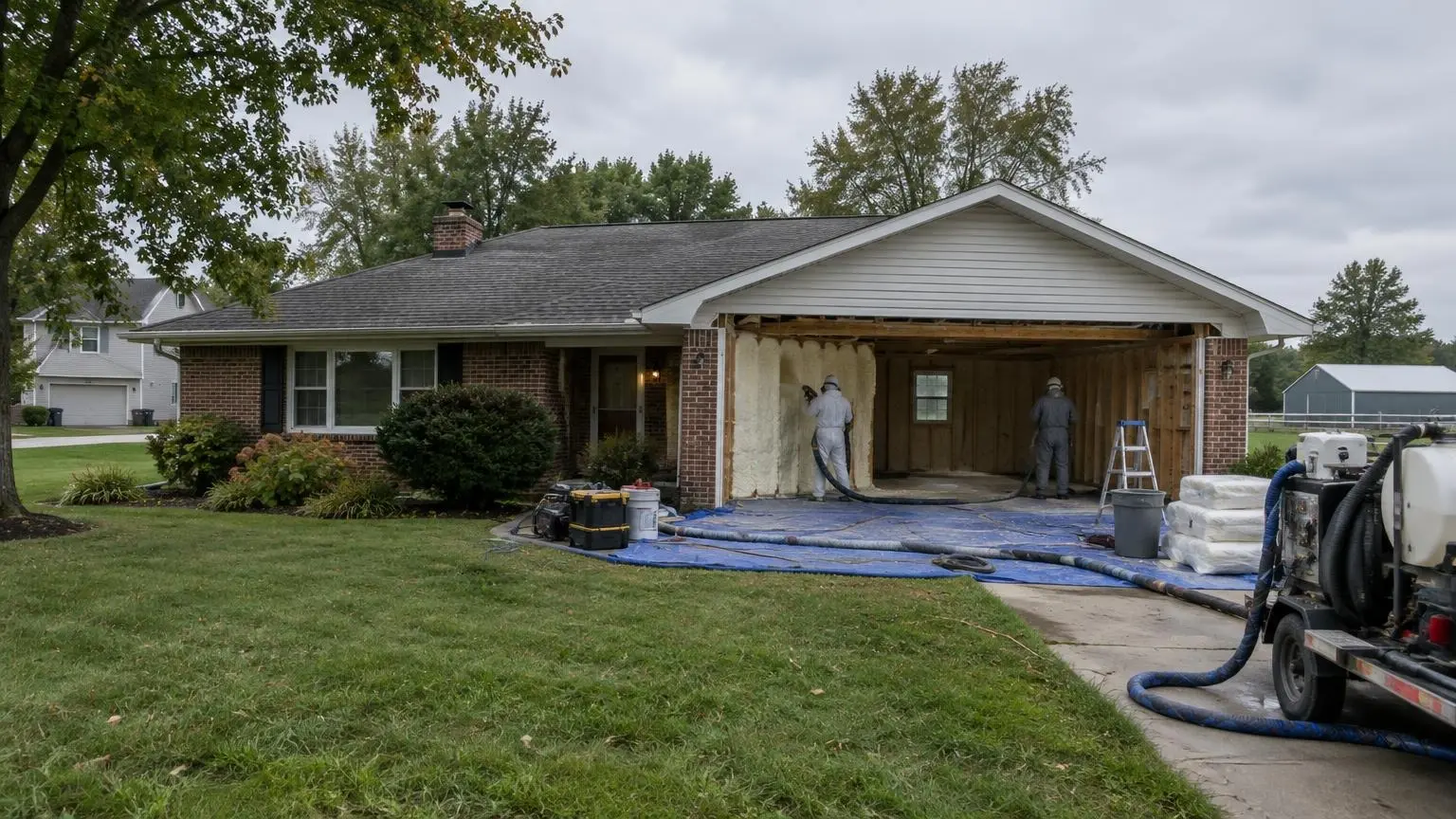
Attic insulation and air sealing in Indianapolis belong together, and sealing comes first. During the heating season, warm air climbs and escapes through every opening in the top-floor ceiling. During the cooling season, the attic turns into an oven, and that heat leaks down into the bedrooms through whatever insulation is there. Closing the openings and then building up the insulation addresses both seasons. Simply adding more fluff to a leaky ceiling does less than people hope, since air passes easily through fiberglass and cellulose.
How much insulation an Indianapolis attic needs
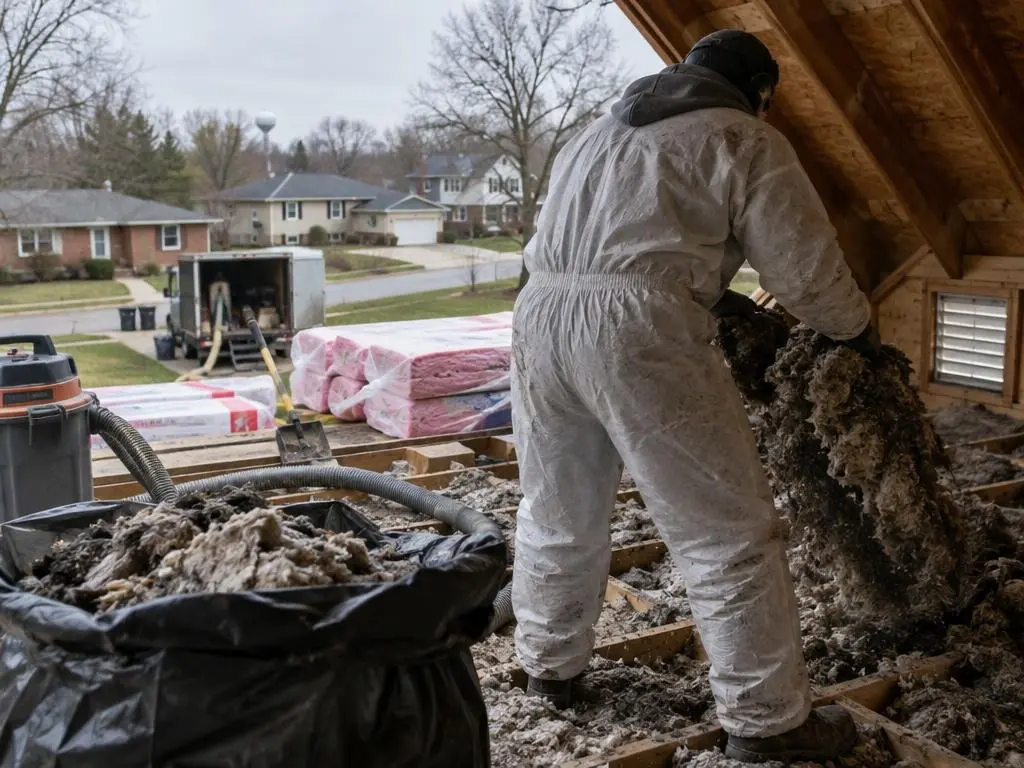
OpenEI puts Marion County in Climate Zone 5A. The Insulation Institute's summary of the 2020 Indiana Residential Code lists R-38 for ceilings in that zone, a figure aimed at new construction. For houses already standing, the Department of Energy aims higher: R-60 when an attic starts empty, or an added R-49 when 3 to 4 inches are already down. HomeGuide rates blown fiberglass at R-2.2 to R-2.9 per inch and cellulose at R-3.1 to R-3.8 per inch, so hitting those marks means a layer well beyond twelve inches. Plenty of attics in the postwar neighborhoods hold only 3 to 6 inches of old fill that has packed down over the decades, or batts with open seams between them.
The leaks we seal
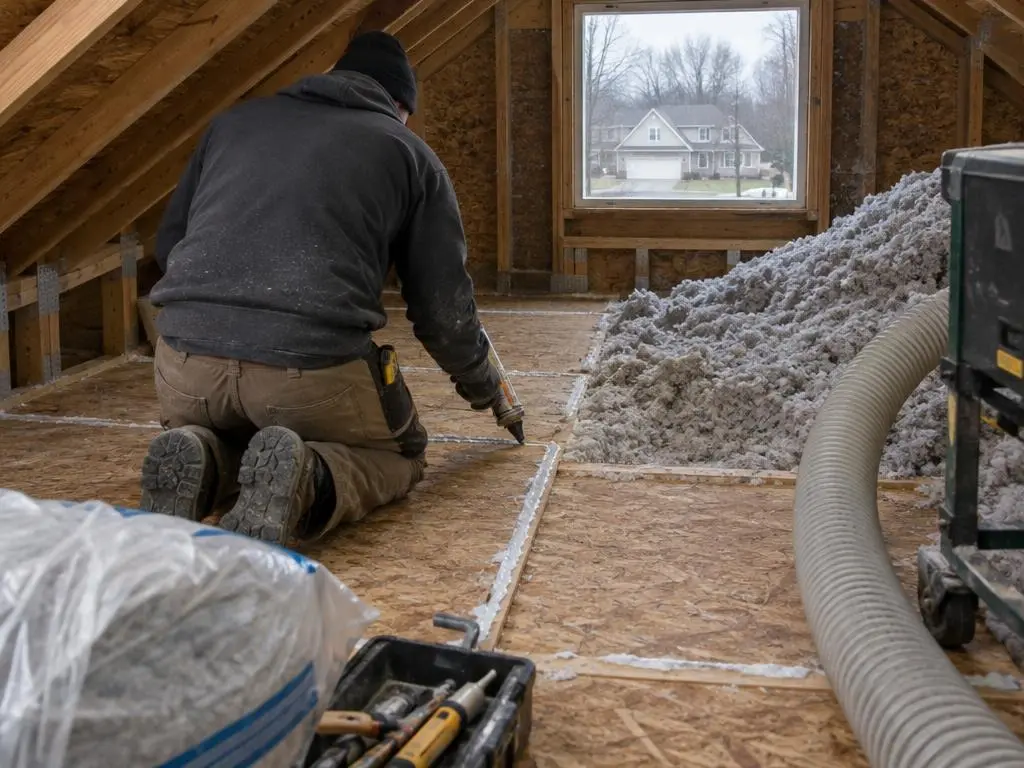
A short list of openings accounts for most of the air moving into a typical attic. Holes for drain stacks and vent pipes are usually cut oversized. Furnace and water heater flues pass through a ring of open space that must be closed with sheet metal and fire-rated caulk; foam is never used against a hot flue. Can lights and ceiling boxes let air through the fixture and around its edge. Some bath fans dump moist air into the attic rather than outdoors. Scuttle hatches and pull-down stairs rarely have a gasket or any insulation. Every interior wall leaves a gap at its top plate. Older houses may also hide open chases over kitchen soffits or beside chimneys that connect directly to the rooms below. Depending on the size of the gap, we close them with foam, caulk, rigid board or weatherstripping.
Hot upstairs rooms in July
Wikipedia's climate table puts the Indianapolis July mean high at 85.2F, and an attic under a dark roof runs much hotter. A thin, leaky attic floor lets that heat radiate and seep into bedrooms, and any ductwork up there picks it up too. Sealing the floor, insulating to depth and keeping soffit and ridge vents clear lowers the heat load on the upstairs and the air conditioner. If ducts run through the attic, we check them as well; a leaking supply duct in a hot attic can cancel out much of the benefit.
Ice at the eaves
The National Weather Service lists 25.5 inches as the Indianapolis normal seasonal snowfall, with the first inch-plus snow averaging December 8 and the last March 1. Ice dams are less common here than farther north, but a heavy snow followed by a cold week can still build them where heat leaks into the attic. The cure is the same: seal the attic floor, add insulation, and keep the roof deck cold with clear soffit vents and baffles.
Cape Cods, bonus rooms and vaulted ceilings
The Cape Cods and story-and-a-halfs in older neighborhoods have sloped ceilings with short attic pockets behind knee walls, and loose fill does not stay put in those spaces. Our usual approach is to spray the knee walls and the strip of floor behind them, then deal with the slopes and the upper attic as their own areas. Suburban bonus rooms over garages present the same puzzle. Where a vaulted ceiling follows the rafters with no attic above, closed-cell under the sheathing is about the only option short of new roofing.
Ventilation and baffles
Before new insulation goes in, we install baffles at the soffits so the insulation does not block the air path from soffit to ridge. We confirm that bath and kitchen fans exhaust outside. An attic sealed from below and ventilated above stays drier in winter and cooler in summer.
Each attic job begins with an inspection and a list of what we found, followed by a written quote with air sealing and insulation priced on separate lines. Get a free estimate
What an Attic Job Includes
Air sealing, insulation and the details that keep an attic dry.
Top plates and bypasses
Gaps around wiring, pipes, chases and interior wall tops closed with foam, caulk or board.
Scuttles and pull-down stairs
A gasket plus an insulated lid so the access stops leaking.
Flue and chimney gaps
Sheet metal and fire-rated caulk around hot flues, never foam.
Soffit baffles
Chutes that hold insulation back from the eave vents.
Blown-in to depth
Cellulose or fiberglass to the quoted R-value, with rulers you can see from the hatch.
Kneewalls and bonus rooms
Foam on short walls and attic pockets in Cape Cods and rooms over garages.
Published Attic Insulation & Air Sealing Costs
| Job | Range and source |
|---|---|
| Typical attic insulation job | $1,000 to $2,700, roughly $1,800 on average (HomeGuide) |
| Air sealing | $350 to $3,000 (HomeGuide) |
| Blown-in over the attic floor | $0.90 to $2.40 per sq ft (HomeGuide attic guide) |
| Foam across the attic floor | $1,100 to $6,800 (HomeGuide) |
| Foam under the roof deck | $1,500 to $9,000 (HomeGuide) |
| Attic spray foam in an existing home | $2,500 to $12,000 (Fixr) |
| Removing old insulation | $1 to $2 per sq ft (HomeGuide) |
Pulled from HomeGuide's January 2026 attic guide and Fixr's 2025 spray foam guide; both are nationwide averages. How much sealing the attic needs, the target depth, access and any tear-out shift the cost. We price your attic after seeing it, and the written estimate is final.
How We Handle an Attic
1. Inspection
We measure existing depth, find the bypasses, check vents and ducts, and look for leaks, mold or vermiculite.
2. Quote
Sealing and insulation priced as two lines, with the R-value we are aiming for.
3. Sealing
Bypasses, top plates, chases and the access get closed; baffles go in at the eaves.
4. Insulating
Loose fill blown to depth with visible rulers, or foam where foam fits.
5. Review
We show you what was closed up and how deep the new layer is.

Why Choose Us for Attic Insulation & Air Sealing
Sealing priced separately
You can see exactly what the air sealing costs and covers.
Eave vents protected
Baffles go in before the insulation so the soffits still breathe.
Depth you can verify
Rulers stay in the attic so you can check the depth any time.
Attic Insulation & Air Sealing Questions
What is the attic insulation requirement in Indiana?
The Insulation Institute's summary of the 2020 Indiana Residential Code lists R-38 for ceilings in Climate Zone 5, which covers the Indianapolis area. For existing attics, the Department of Energy recommends R-60 if there is none and adding R-49 over 3 to 4 inches. Permit needs vary by city, so check before a remodel.
Will more attic insulation cool my upstairs?
It helps most when the attic floor is sealed first and ducts in the attic are sealed too. Insulation slows heat coming through the ceiling; sealing stops hot attic air from leaking down.
Can new insulation go on top of the old?
In most attics, yes, if the existing layer is dry and clean. We often move some of it aside to seal the gaps underneath, then blow the new layer over everything.
Is blown-in or spray foam better for an attic floor?
On an open attic floor, sealing the leaks and blowing in cellulose or fiberglass usually reaches the target for less. Foam makes more sense on kneewalls, short attic floors and roof decks without an attic.
When is the best time of year for attic work?
Spring and fall are most comfortable, since Indianapolis attics get very hot in summer. We can work year round, starting early in the day when it is hot.
Attic Insulation & Air Sealing Service Areas
- Spray Foam Insulation in Indianapolis, IN
- Spray Foam Insulation in Carmel, IN
- Spray Foam Insulation in Fishers, IN
- Spray Foam Insulation in Noblesville, IN
- Spray Foam Insulation in Westfield, IN
- Spray Foam Insulation in Zionsville, IN
- Spray Foam Insulation in Whitestown, IN
- Spray Foam Insulation in Lawrence, IN
- Spray Foam Insulation in Speedway, IN
- Spray Foam Insulation in Beech Grove, IN
- Spray Foam Insulation in Greenwood, IN
- Spray Foam Insulation in Franklin, IN
- Spray Foam Insulation in Greenfield, IN
- Spray Foam Insulation in McCordsville, IN
- Spray Foam Insulation in Brownsburg, IN
- Spray Foam Insulation in Avon, IN
- Spray Foam Insulation in Plainfield, IN
- Spray Foam Insulation in Danville, IN
- Spray Foam Insulation in Mooresville, IN
- Spray Foam Insulation in Martinsville, IN
Get an Attic Insulation & Air Sealing Estimate
Hot upstairs or high bills? We will check the attic and write up a sealing and insulation plan.